About
I work in the Machine Learning group at Luleå University of Technology, Sweden, where I am supervised by Marcus Liwicki and Denis Kleyko (Örebro University). My research is on neuro-inspired architectures, specifically recurrent networks whose units are divided into excitatory and inhibitory populations. I study when such networks remain stable and whether that structure makes them more robust to corrupted input.
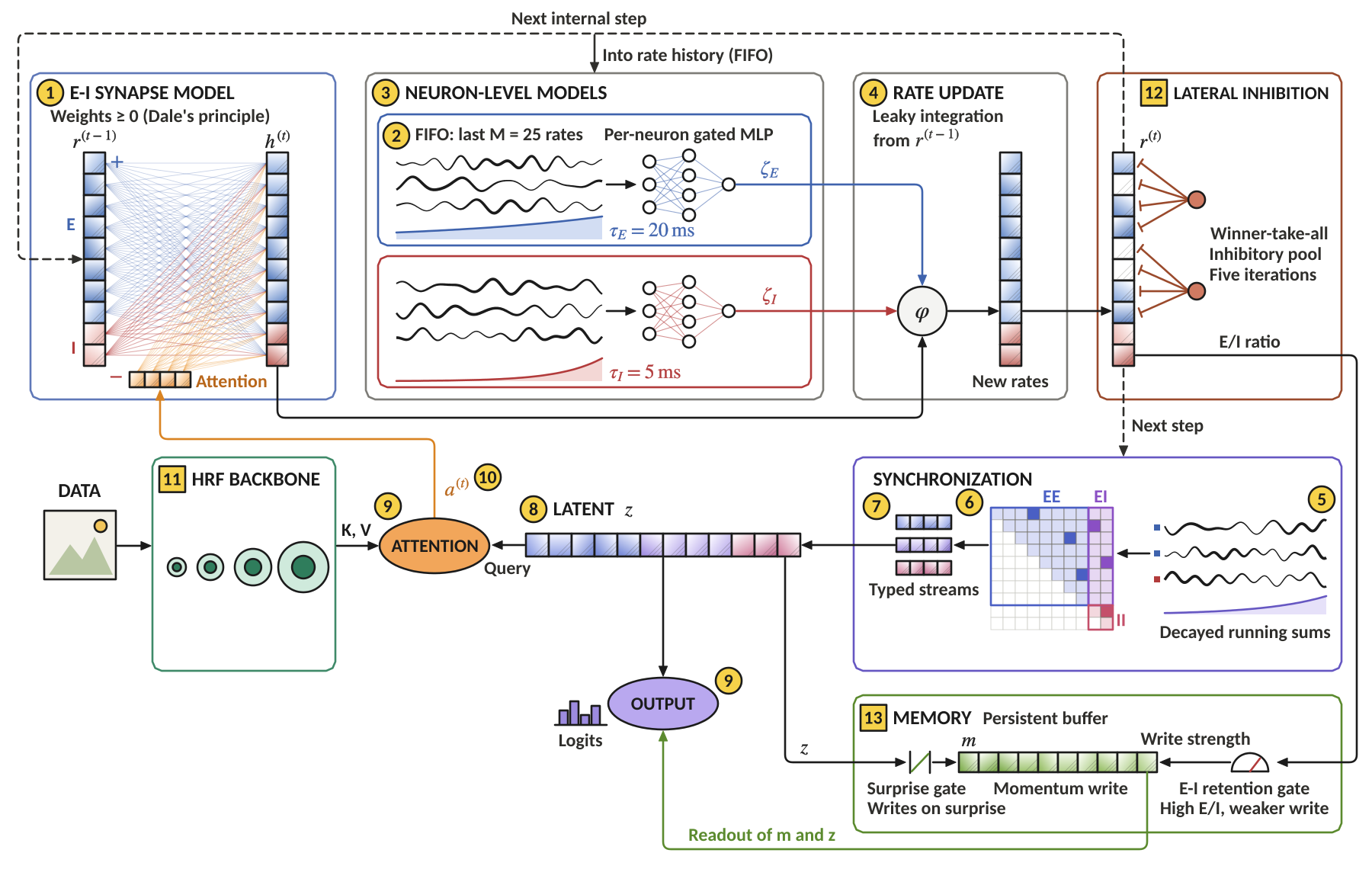
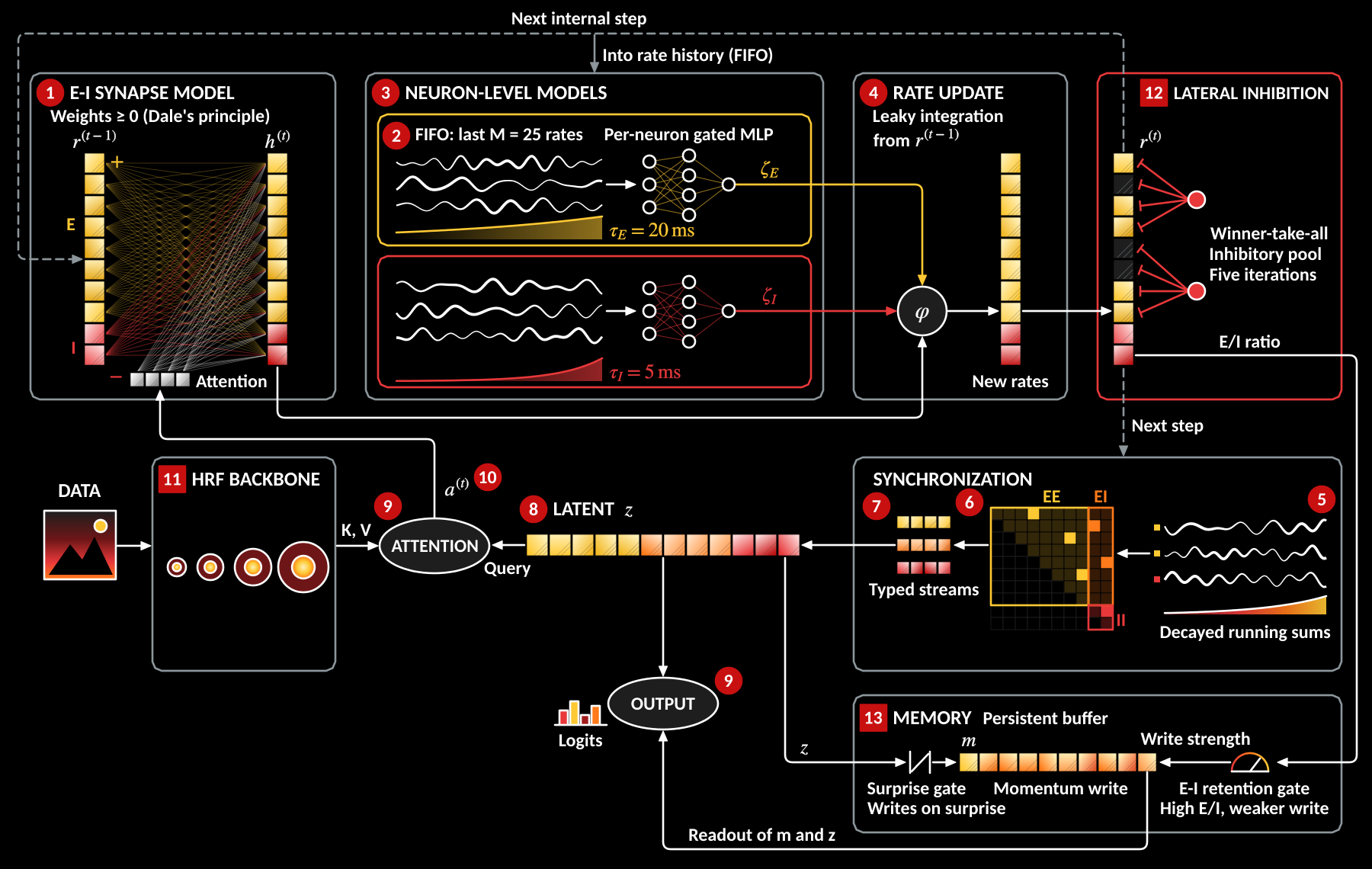
This work led to TIDE, written with both supervisors and accepted to NeurIPS 2026. TIDE extends the Continuous Thought Machine with Dale-constrained Wilson-Cowan dynamics, lateral inhibition, and a surprise-gated memory, and the paper supports the design with proofs of convergence and stability.
My earlier work was done in the university's Robotics and Artificial Intelligence group. There I worked on perception, which included filtering smoke out of LiDAR point clouds for search-and-rescue robots, segmenting power lines in LiDAR scans, and recording a multimodal dataset in an underground environment. I also worked on autonomous orbit management for satellites in low Earth orbit, using deep reinforcement learning.
Research interests
- Representation learning
- Statistical learning
- Robotics
- Multi-agent systems
- Neuroscience
- Neuromorphic computing
- Machine learning
News
-
TIDE to be presented as a poster at the NeurIPS 2026 satellite event in Paris.
-
TIDE: Asymmetric Neural Circuits for Stabilized Temporal Inhibitory-Excitatory Dynamics (with Denis Kleyko and Marcus Liwicki) accepted to NeurIPS 2026.
-
TIDE preprint released: arXiv:2605.19403.
-
Article on autonomous orbit management for low-earth-orbit satellites published in the European Journal of Control (project page).
Projects
-
TIDE
A recurrent architecture built from excitatory and inhibitory populations: Dale-constrained Wilson-Cowan dynamics, lateral inhibition, and a surprise-gated memory, compared against the Continuous Thought Machine.
-
Autonomous orbit management
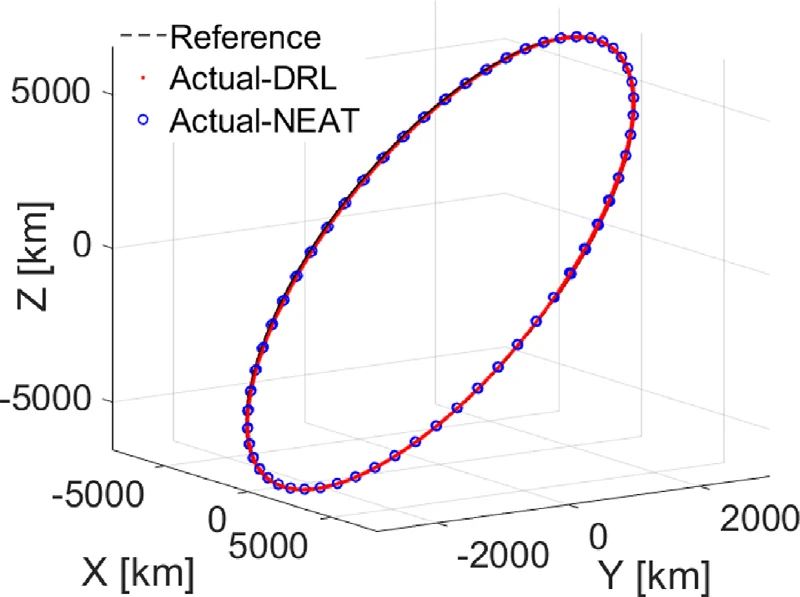
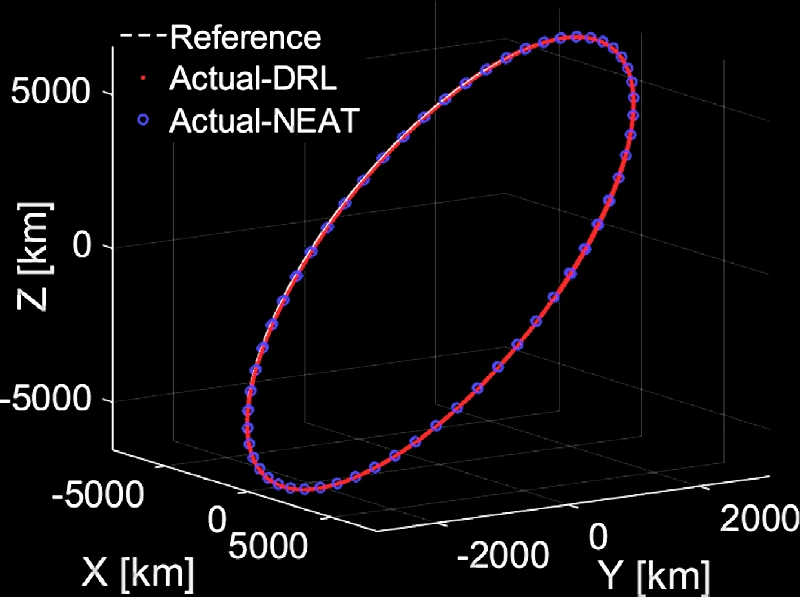
Station-keeping for low-thrust satellites in low-earth orbit, learned with deep reinforcement learning and with neuro-evolution in the same environment.
Selected publications
-
TIDE: Asymmetric Neural Circuits for Stabilized Temporal Inhibitory-Excitatory Dynamics
40th Conference on Neural Information Processing Systems (NeurIPS), 2026 NeurIPS 2026 Conference paper
BibTeX
@inproceedings{ anonymous2026tide, title={{TIDE}: Asymmetric Neural Circuits for Stabilized Temporal Inhibitory-Excitatory Dynamics}, author={Anonymous}, booktitle={The Fortieth Annual Conference on Neural Information Processing Systems}, year={2026}, url={https://openreview.net/forum?id=dwcrK8NHpm} } -
European Journal of Control, vol. 80, 101052, 2024 Journal article
BibTeX
@article{kyuroson2024orbit, title = {Towards fully autonomous orbit management for low-earth orbit satellites based on neuro-evolutionary algorithms and deep reinforcement learning}, author = {Kyuroson, Alexander and Banerjee, Avijit and Tafanidis, Nektarios Aristeidis and Satpute, Sumeet and Nikolakopoulos, George}, journal = {European Journal of Control}, volume = {80}, pages = {101052}, year = {2024}, doi = {10.1016/j.ejcon.2024.101052} } -
Autonomous Point Cloud Segmentation for Power Lines Inspection in Smart Grid
22nd IFAC World Congress. IFAC-PapersOnLine, vol. 56, no. 2, pp. 11754–11761, 2023 Conference paper
BibTeX
@article{kyuroson2023powerlines,
  title   = {Autonomous Point Cloud Segmentation for Power Lines Inspection in Smart Grid},
  author  = {Kyuroson, Alexander and Koval, Anton and Nikolakopoulos, George},
  journal = {IFAC-PapersOnLine},
  volume  = {56},
  number  = {2},
  pages   = {11754--11761},
  year    = {2023},
  doi     = {10.1016/j.ifacol.2023.10.562}
}